

Key Details
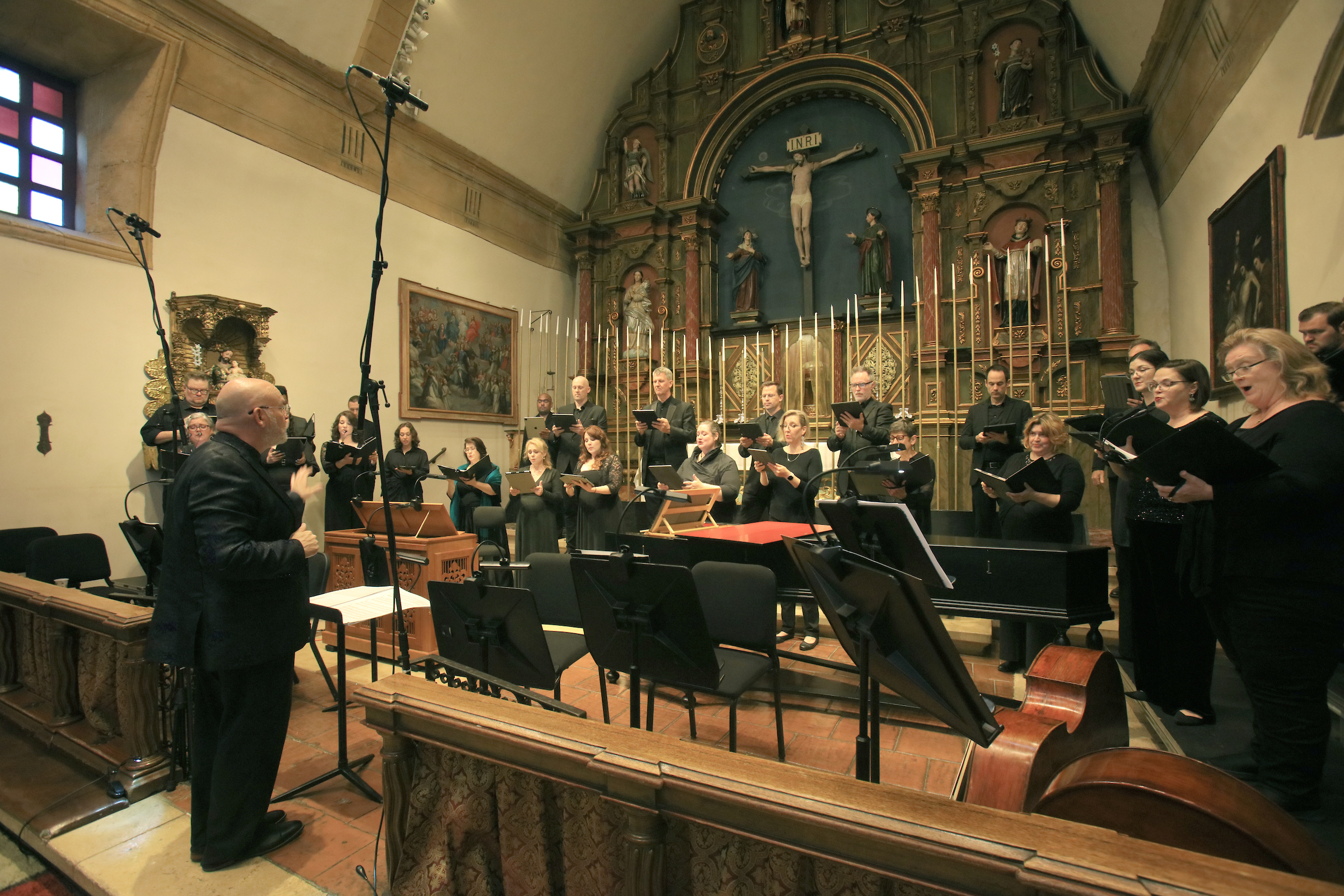
Carmel Mission Basilica
July 15 & 22 at 8:30 PM
Program
RAMONA LUENGEN
In tiefsten Nachten
FRANK MARTIN
Mass for Double Choir a cappella
PAUL HINDEMITH
Six Chansons
EINOJUHANI RAUTAVAARA
Die erste Elegie
STEPHEN ANDREW TAYLOR
Only Yes
J.S. BACH
Partita No. 3 in E major for Solo Violin, BWV 1006

About the Program
Set within the historic Carmel Mission, this choral concert highlights the work of Rainer Maria Rilke, often called “Nature’s Poet”. The program alternates between Rilke-inspired works and Frank Martin’s Mass for Double Choir. Think of the program as a spiral rather than a straight line: each return to a new Mass movement is reframed by the Rilke-inspired work that precedes it.
Paul Hindemith’s Six Chansons is elegantly set Rilke’s poems, which depict fleeting moments of truth through vivid descriptions of the natural world. Ramona Luengen’s In tiefsten Nächten sets a poem from Rilke’s early collection The Book of Hours, addressing the poet’s early reflections on faith and solitude. Stephen Andrew Taylor’s Only Yes draws on a letter in which Rilke reflects on death, while Einojuhani Rautavaara’s Die erste Elegie transforms one of Rilke’s most admired poems into a powerful work that examines human fragility and the boundary between the earthly and the infinite.
Together, Martin’s Mass and Rilke’s words explore the human experience of transcendence, and how that experience is reflected in the natural world.



Program Notes
Luengen and Rilke
Das Stundenbuch (The Book of Hours), published in 1905, is probably the most important of Rilke’s early works, imbued with the spirit of German Romanticism. They are the thoughts of a fictive monk, and explore the search for God and the nature of prayer. In tiefen Nachten’s dreamlike, lyrical imagery is typical of the collection. In it our hero describes his search for an unspecified treasure: “In deepest night I dig for you.” After they are bloodied in the effort, he raises his hands like branching trees: “I seize you out of space, as though you had shattered yourself there . . . and were falling now . . . from distant stars back to earth, as gently as spring rains.
Hindemith and Rilke
“Animals see the unobstructed world with their whole eyes. But our eyes, turned back upon themselves, encircle and seek to snare the world, setting traps for freedom.”
Hindemith first set the poetry of Rilke as a young composer in 1923. Sixteen years later, he turned again to Rilke’s words for the Six Chansons, whose texts come from Vergers, a collection of 59 French poems which Rilke published in 1924 (Rilke wrote over 400 poems in French, mostly arresting miniatures such as the texts heard tonight). Both Hindemith and Rilke fled Germany for Switzerland; the poet settled there in 1920, seeking a refuge from the devastation of World War I, while the composer lived there in 1938, after fleeing the Nazi regime. After he was given these poems by a Swiss choral conductor, Hindemith delivered a finished score four days later. The first two chansons are portraits of animals – “La Biche” (“The Doe”), which contemplates the deer balanced between repose and a readiness to spring into motion, and “Un cygnet” (“The Swan”), which compares the image of the swan to an encounter with a beloved who “swims on our troubled soul”, bringing to us the double emotion of “happiness – and of doubt.” The third chanson, “Puisque tout passe”, explores the fleeting nature of time, while the fourth and fifth movements are concerned with seasons of the year. The final chanson is “Verger” (“The Orchard”). This mystical poem centers on the calm stillness and transcendence that can be found in nature.
Rautavaara and Die erste Elegie
In 1912, Rilke was living on a cliff above the Adriatic Sea in the Duino Castle. On a stormy evening “Rilke climbed down . . . to the foot of the castle . . . These cliffs fall steeply, for about two hundred feet, into the sea. Rilke paced back and forth, deep in thought . . . Then, all at once, in the midst of his brooding, he halted suddenly, for it seemed to him that in the raging of the storm a voice called to him”, a question and a cry which summarized his sense of loneliness and alienation: ‘Who, if I cried out, would hear me among the angels’ hierarchies?’ By that evening the entire elegy had been written down.” In the next few months he completed a second elegy and half of the third. Then a curtain descended, and with it silence. He found himself unable to write. Ten years after the angelic voice in the storm, in early 1922, the poetic floodgates re-opened. In a few weeks he wrote the Sonnets to Orpheus a cycle of fifty-five poems, along with the remaining ten Duino Elegies.
Einojuhani Rautavaara, one of the greatest Finnish composers of the last generation, writes:
My youthful encounter with the poetry of Rainer Maria Rilke turned out to be quite a discovery, not only in literary terms but also for the development of my world view. . . From that time onwards I continued to carry with me - both mentally and in my suitcase - the Duino Elegies, Rilke's seminal work. Over the years I would take it out, finding myself particularly drawn to the first elegy, whose angel figure took on the role of a personal ‘animus’. . . Only as late as 1993, however, . . . did I feel that the time had come to set the angel elegy. It had evidently matured in my subconscious in the interim, since the process of composing the work was swift, eager and fluently self-assured.
Die erste Elegie has been one of the most admired and performed choral works of the late 20th century, especially in the Scandinavian countries, loved for its power, evocativeness, and virtuosity.
Stephen Taylor and “Only Yes”
The text for Stephen Andrew Taylor’s Only Yes comes from a letter Rilke wrote to a patron and friend. In it he explains his belief that death is not to be feared, but to be embraced. This text is particularly important to me – my most important mentor, Joseph Flummerfelt, shared these words with me in the hours before his death, as a gift which could (in the words of the First Elegy), “comfort and help and support us.”
Mass for Double Choir
Frank Martin composed the Mass in Switzerland between 1921 and 1924, during the same time and in the same country Rilke was writing his Duino Elegies. Although it was written as a private offering to God, and not intended for public performance, it has become one of the most beloved works in the choral canon, delighting and moving audiences and performers with its delicate harmonies and neo-Renaissance polyphony, and its sincere sense of faith.
Bach Partita
During Rilke’s time in Switzerland, he wrote that he was listening exclusively to the music of Bach, which he felt mirrored his own attempts to write poetry that evoked the meeting of the human and the divine.
—Written by Andrew Megill


